

Choosing between replacing, refacing, and refinishing your kitchen cabinets comes down to three things: the condition of your existing cabinets, how well the layout works, and how much you want to change the finished look. If your cabinets are solid and the layout works, refinishing or refacing may be enough. But if the cabinets are damaged, poorly built, or no longer fit your needs, replacement may be the better long-term investment.
The key is knowing what each option actually involves before deciding.
Every kitchen is a little different. Some homeowners want a fresh appearance without changing the layout. Others want more storage, better access to their cabinets, or a kitchen that works differently altogether.
Before recommending a direction, it's worth looking beyond the cabinet doors.
Are the cabinet boxes still solid? Do the drawers operate properly? Are the cabinets level and securely installed? Does the existing layout make sense for how the homeowner uses the kitchen?
Those answers help determine whether the existing cabinetry is worth keeping or whether starting over makes more sense.
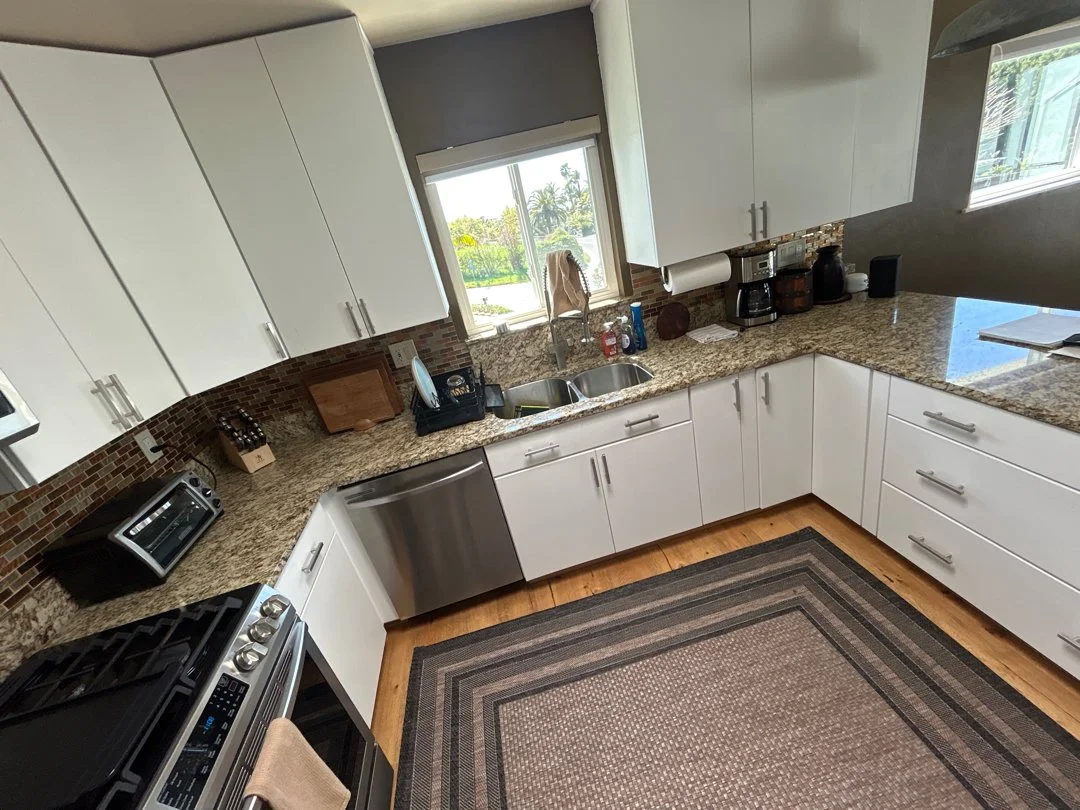
This is a kitchen renovation job we worked on in Encinitas. In this project, we also found that the p-trap leaked, a section of subfloor was soft, some drywall was severely damaged, and the existing microwave vent was poorly attached.
Damage like this is exactly why we check the cabinet boxes before recommending refinishing or refacing. New doors on top of a moisture problem don't fix anything.
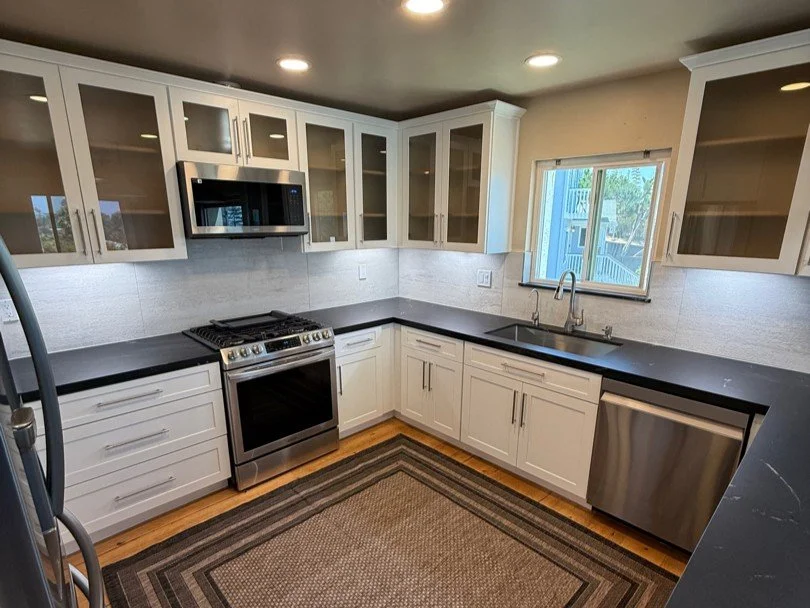
We replaced the cabinets and repaired the damage we uncovered along the way.
Every kitchen is a little different. Some homeowners want a fresh appearance without changing the layout. Others want more storage, better access to their cabinets, or a kitchen that works differently altogether.
Before recommending a direction, it's worth looking beyond the cabinet doors.
Are the cabinet boxes still solid? Do the drawers operate properly? Are the cabinets level and securely installed? Does the existing layout make sense for how the homeowner uses the kitchen?
Those answers help determine whether the existing cabinetry is worth keeping or whether starting over makes more sense.
What's the Difference Between Replacing, Refacing, and Refinishing Kitchen Cabinets?
These three approaches can produce noticeably different results, but they involve different amounts of work.
Cabinet replacement means removing the existing cabinetry and installing new cabinets. This gives you the most flexibility to change the layout, cabinet sizes, storage configurations, and overall appearance.
Cabinet refacing generally means keeping the existing cabinet boxes while replacing the doors and drawer fronts and updating the exposed cabinet surfaces to match. It's an option when the boxes are structurally sound and the layout already works.
Cabinet refinishing means working with the existing cabinet surfaces, typically through preparation, painting, or applying a new finish. This changes the appearance without replacing the cabinet structure.
The important distinction is that refinishing changes the finish, refacing changes much of what you see, and replacement changes the cabinetry itself.
When Does Refinishing Kitchen Cabinets Make Sense?
Refinishing is worth considering when your existing cabinets are in good condition but the color or finish feels outdated.
Maybe the doors are still in good shape, the drawers function properly, and the cabinet boxes are sturdy. You simply want a different appearance.
In that situation, refinishing may accomplish what you need without removing cabinets that still have plenty of useful life.
But surface preparation matters.
A good finish depends on cleaning, sanding or other appropriate preparation, and choosing a coating system compatible with the existing surface. Cabinets see frequent handling, moisture, cooking residue, and everyday wear.
Not every cabinet material is equally suitable for refinishing, either. Some factory-finished or laminated surfaces require special preparation, and others may not be good candidates.
Before committing, have the existing finish and cabinet material evaluated.
Is Cabinet Refacing Better Than Replacing?
Refacing can be a good middle ground when the cabinet boxes are solid and the homeowner likes the existing kitchen layout.
It allows you to update the doors, drawer fronts, and visible cabinet surfaces while keeping much of the original cabinetry in place.
That can make sense if your biggest complaint is the appearance of the doors rather than the function of the kitchen.
However, refacing doesn't solve every problem.
If your base cabinets are too small for what you need, the layout creates awkward working areas, or the cabinet boxes have deteriorated, new doors won't correct those issues.
You also need to consider the condition and construction of the existing boxes. New doors and hardware still depend on a stable cabinet structure.
From a carpenter's perspective, the question isn't simply whether the cabinets look old. It's whether the cabinets underneath are worth investing in.
When Should You Replace Kitchen Cabinets Completely?
Replacement makes the most sense when the existing cabinets no longer meet the homeowner's needs or aren't in suitable condition to reuse.
For example, a homeowner might want to reconfigure the kitchen, change the location of certain cabinets, create more usable storage, or accommodate a different appliance arrangement.
Those changes can be difficult or impractical with existing cabinet boxes.
Replacement also deserves consideration when cabinets have significant moisture damage, weakened materials, failing joints, or other problems affecting their structural integrity.
New cabinetry gives you the opportunity to plan the kitchen around how you actually use it.
That includes thinking about drawer access, cabinet heights, storage locations, appliance clearances, and the relationship between cabinets and countertops.
The downside is that replacement is a larger project. Depending on the scope, it may involve demolition, wall repairs, countertop work, plumbing adjustments, or electrical coordination.
That's why cabinet replacement should be planned as part of the overall kitchen, not treated as an isolated installation.
How Can You Tell If Your Existing Cabinets Are Worth Keeping?
Start with the cabinet boxes rather than the doors.
Open the cabinets and look at the interior surfaces, especially around the sink and other areas exposed to moisture.
Check for swelling, separation, soft material, or visible deterioration.
Next, look at the doors and drawers. Are they aligned? Do they close properly? Are the hinges securely attached? Do the drawer slides operate smoothly?
Some problems can be corrected with adjustments or hardware replacement. Others point to more extensive wear or damage.
Also pay attention to how the cabinets were originally installed.
Cabinets that are out of level, poorly supported, or improperly secured may need corrective work before refinishing or refacing is worthwhile.
Finally, consider the layout.
Even well-built cabinets may not be worth keeping if they make the kitchen frustrating to use every day.
Is It Cheaper to Reface, Refinish, or Replace Kitchen Cabinets in San Diego?
Using the Encinitas kitchen pictured above as an example, here's roughly how the three options compare:
Refinishing (painting the existing cabinets): about $6,000–$7,000 for a kitchen this size.
Refacing (new doors and drawer fronts, plus paint): the new doors alone usually cost about $300–$400 each to have made, because they're built to precise measurements. On top of that, there's the labor to measure, remove the old doors, install and adjust the new ones, and paint the doors and cabinet boxes so everything matches. For a kitchen like this, that typically comes to roughly $11,000–$14,000 all in.
Full replacement: the total value of this project, including new cabinets, countertops, backsplash, labor and materials, was about $35,000, not including appliances. (The homeowner bought some of the materials directly.)
Every kitchen is different. The number of doors and drawers, the materials, and the condition of the boxes all change the price. Treat these as ballpark figures, not a quote.
What Should You Decide Before Ordering New Kitchen Cabinets?
Before ordering cabinets, settle the layout.
Think about what currently works and what doesn't. Consider where you prepare food, store cookware, access appliances, and move around the kitchen.
Then confirm measurements and appliance requirements.
Cabinet dimensions, door clearances, filler pieces, finished panels, and countertop support all matter during installation.
This is especially important when replacing cabinets while keeping some existing kitchen elements.
A cabinet may fit the available wall space but still interfere with a nearby door, appliance, or drawer.
Getting those details right during planning helps avoid unnecessary modifications during installation.
For a kitchen remodel involving multiple trades, it's also worth discussing whether any layout changes could require permits or additional review. Requirements depend on the specific work and local jurisdiction.
Which Kitchen Cabinet Option Is Right for Your Home?
If you like your kitchen layout and the cabinets are solid, start by exploring refinishing or refacing.
If you want different storage, a new layout, or need to address deteriorated cabinetry, replacement is worth considering.
There's no single answer that fits every San Diego kitchen.
The best decision comes from understanding what you already have, what you want to improve, and how much of the existing cabinetry can reasonably be reused.
Good carpentry isn't always about replacing everything. Sometimes it's knowing what should stay.
See more of our kitchen remodels in San Diego!
Frequently Asked Questions
How much does it cost to refinish, reface, or replace kitchen cabinets in San Diego?
Using the Encinitas kitchen as an example, refinishing existing cabinets typically costs around $6,000–$7,000, while refacing with new doors, drawer fronts, and paint ranges from $11,000–$14,000. Full cabinet replacement, including new cabinets, countertops, backsplash, labor, and materials, can total approximately $35,000, excluding appliances. Actual costs in San Diego may vary depending on kitchen size, materials, and project scope.
Can I reface my kitchen cabinets without changing the countertops?
Often, yes. If the cabinet boxes remain in place and are suitable for refacing, the existing countertops may be able to stay. Their condition and how they're supported should be evaluated first.
Can damaged kitchen cabinets be refinished?
Minor cosmetic damage may be repairable before refinishing. Cabinets with significant swelling, deterioration, or structural damage may need more extensive repairs or replacement.
Will replacing kitchen cabinets require new flooring?
Not necessarily. It depends on how the existing flooring was installed and whether the new cabinet layout changes the areas covered by cabinetry. Flooring transitions and exposed areas should be checked during planning.
If you're considering a kitchen cabinet update in San Diego, reach out to Huge Home Pros and we'll help you evaluate which approach makes sense for your kitchen. You may also use the Project Estimator at the top of this page!