

For most San Diego door replacement projects, a pre-hung door is usually the better choice. It replaces the door and frame together, giving the installer more control over the fit, especially when an existing opening is uneven or out of square.
A slab door can still make sense when the existing frame is square, solid, and in good condition. But in practice, if there is any question about the condition or alignment of the frame, starting fresh with a pre-hung assembly can avoid trying to fit a new door to an old problem.
The Job
On one of our San Diego jobs, the homeowner wanted several doors replaced with pre-hung doors and the casing updated at the front entrance, a pocket door, and another opening.
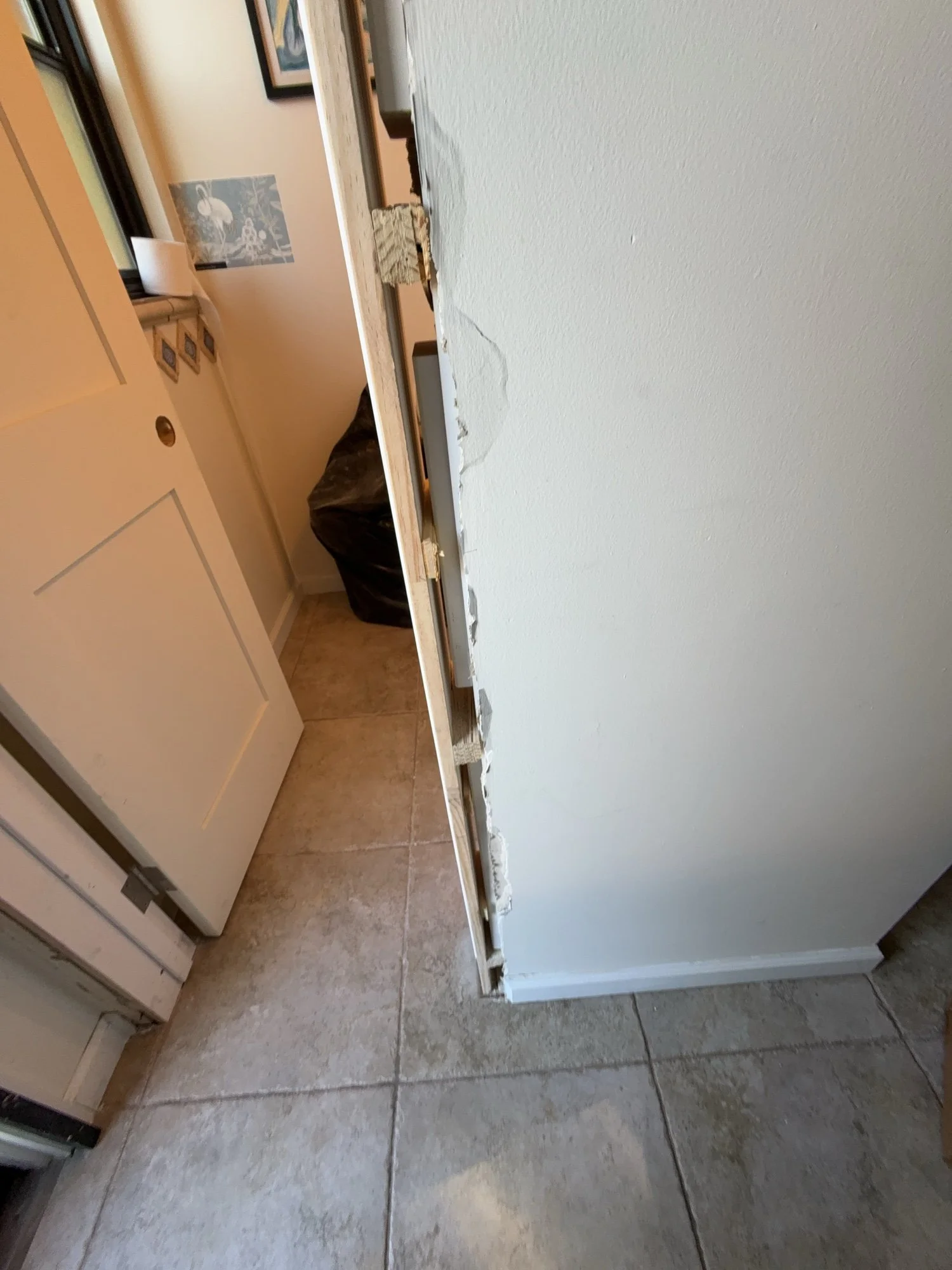
The crew replaced bedroom and bathroom doors and found that the guest bathroom opening was too tight and out of plumb for the new door. To create enough room to install the door plumb, the crew replaced a 2x4 with a 1x4 at that opening.
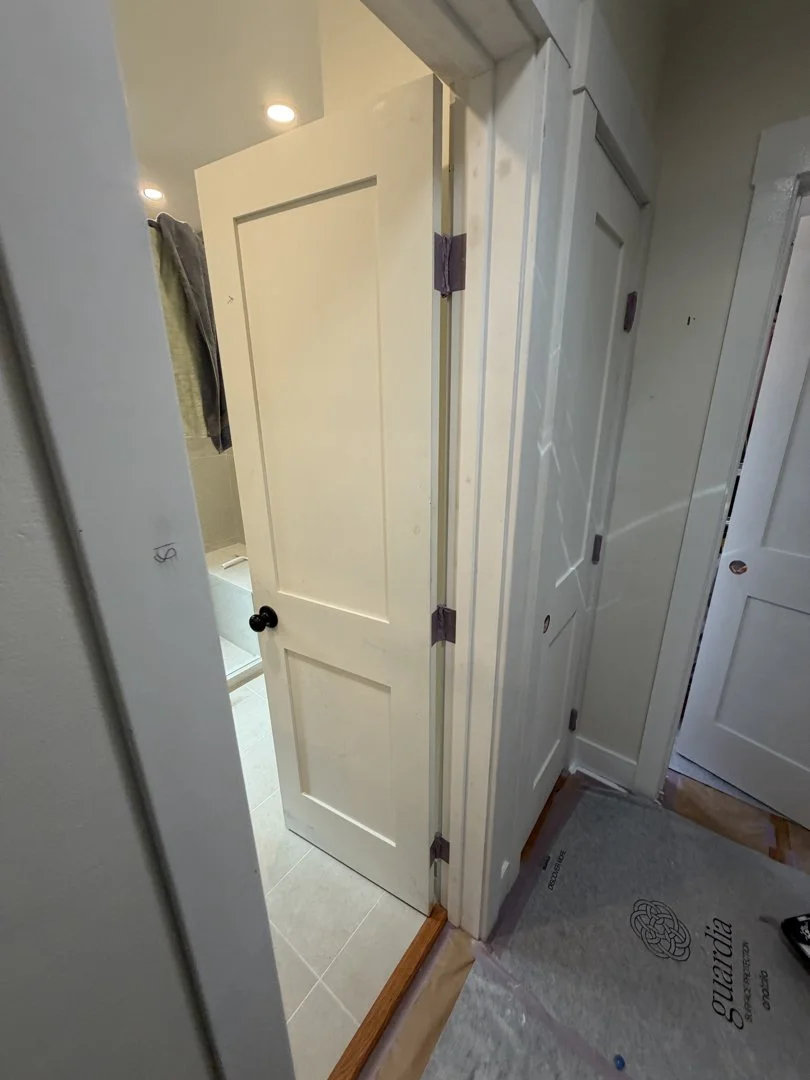
They also added blocking to stabilize a bathroom jamb, fitted and finished the trim, painted the doors and trim, and installed the hardware. Some jambs were uneven, built-up plaster could leave small gaps in the trim, and a door striker was sticking.
That job is a good example of why we generally favor pre-hung doors. The condition of the opening and frame matters just as much as the door itself. Replacing the frame gives the installer more opportunity to address those issues rather than trying to make a new slab work with an existing frame that may already be part of the problem.
What is the difference between a slab and a pre-hung door?
A slab is the door itself, without a surrounding frame. Depending on the door you select, it may need to be prepared for hinges and a latch. A carpenter fits it to the existing frame, paying close attention to clearances, hinge locations, and how the latch meets the strike plate.
A pre-hung door comes mounted in its own frame, usually with the hinges already attached. The door and frame are installed together as an assembly.
That does not mean a pre-hung door simply gets dropped into the opening. The opening still needs to be checked, and the new frame must be positioned, secured, and adjusted so the door is plumb and operates properly.
Why do we usually recommend a pre-hung door?
A new door is only as successful as the opening it is installed in.
If an existing frame is damaged, uneven, out of square, or poorly fitted, installing a slab means working around those existing conditions. A pre-hung assembly gives the installer the opportunity to replace the door and frame together and establish a better fit.
This can be particularly useful in an older San Diego home, where the opening may no longer be perfectly square or plumb.
The guest bathroom from our San Diego job is a good example. Even a pre-hung door did not automatically solve the problem. The opening itself had to be modified before the new assembly could be installed plumb.
For that reason, we recommend checking the entire opening before choosing or ordering a replacement door.
When does a slab door still make sense?
A slab is worth considering when the existing frame is square, sound, properly fitted, and worth keeping.
For example, you may like the existing trim and frame and simply need to replace a damaged door or want a different style. If the frame provides a reliable place for the new door to hang and close, replacing only the slab may be reasonable.
But a frame that looks fine at first glance still deserves a careful inspection. The opening, hinges, latch position, and clearances all need to work with the new door.
A new slab may require trimming and hardware preparation to fit correctly. Buying a door that appears to be the same size as the old one is not a substitute for checking the actual opening.
Will a pre-hung door fix a door that sticks?
It can help when the problem involves the existing frame, but the cause of the sticking should still be identified first.
The door itself may be rubbing, the hinges may need attention, or the frame and opening may be out of alignment. Simply replacing the door without understanding the problem can leave you dealing with the same frustration afterward.
Look at where the door rubs and whether the gaps around it change as it closes. Those clues help a carpenter evaluate the door, hardware, frame, and opening together.
What should you check before ordering a pre-hung door?
Start with the actual opening rather than assuming its dimensions based on the existing door.
For a pre-hung assembly, the opening, jamb depth, and direction the door swings all matter. Confirm the handing and swing with your supplier or installer before ordering, since door terminology can be confusing.
Also look beyond the door. Flooring, baseboards, casing, and nearby wall surfaces can affect the installation and finish work.
Removing an existing frame can also affect the surrounding casing or wall surfaces. Ask what is included in the installation and what may need to be repaired or repainted afterward.
Will you need a permit?
Permit requirements depend on where the door is located and the scope of the project. A straightforward replacement and a project that changes an opening may be treated differently.
Before work begins, check with the local building department or ask your contractor to confirm what applies to your specific project.
So, should you choose a slab or pre-hung door?
For most replacement projects, we would start by considering a pre-hung door. Replacing the door and frame together gives the installer more control over the finished fit and avoids relying on an existing frame that may be uneven, damaged, or out of square.
A slab can still be a good option when the existing frame is in excellent condition and you have a specific reason to keep it. But if you are already investing in a new door and the condition of the frame is questionable, replacing the complete assembly is often the more practical approach.
Either way, careful measurement and an inspection of the opening before ordering can prevent surprises once installation begins.
Frequently Asked Questions
How much does it cost to install a pre-hung door?
There are a lot of variables. An inexpensive hollow-core door may cost around $200, while a good-quality builder-grade door can be around $450–$650. The labor involved in hanging the door is roughly the same even when the door itself is more expensive.
For a single pre-hung door already onsite, with basic trim and no painting, our labor is usually around $550. A pre-hung door with basic trim generally takes about four hours, while more elaborate trim takes longer. Installing several doors at once can reduce the amount of time required per door.
You should also account for removing and hauling away the old door when needed.
Does a pre-hung door include trim?
Do not assume it does. Confirm what comes with the specific door you are buying and discuss the casing and other finish work with your installer.
Can I install a slab door in my existing frame?
Yes, if the frame is in good condition and properly aligned. The hinge locations, latch placement, clearances, and actual dimensions still need to be checked before preparing the new door.
Have a door project in mind? Reach out to Huge Home Pros and tell us about your door project needs. You may also check out our service pages Door Installation and Repair and Finish Carpentry to know more!
Huge Home Pros, licensed B-2 contractor (CA #1096361)